



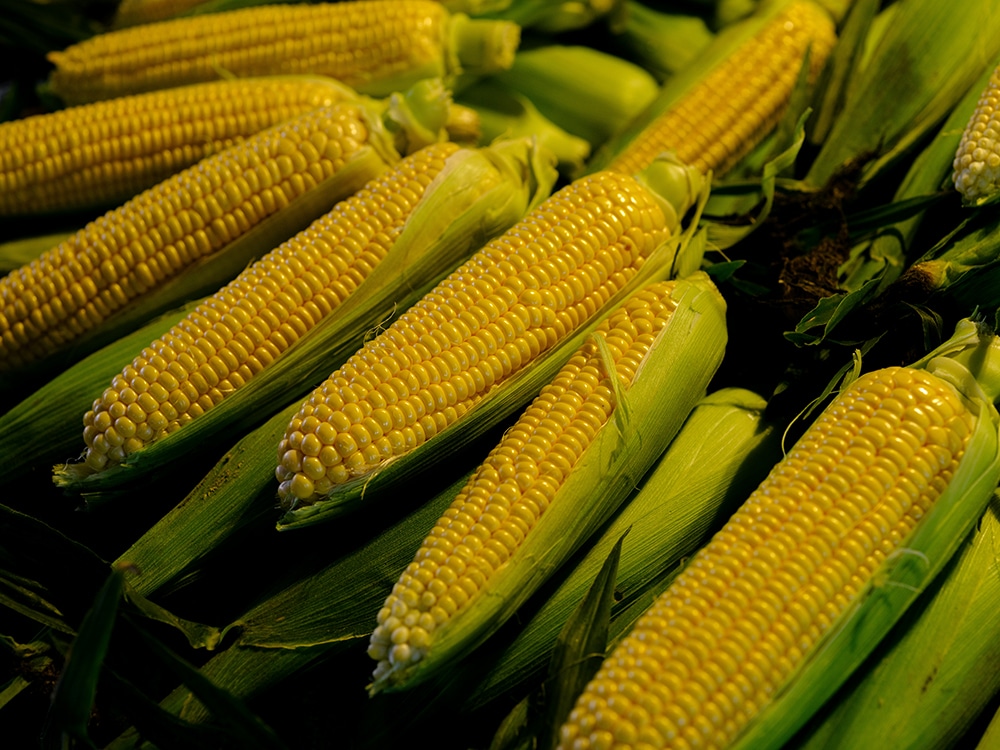
The ‘camel’s cobbles’, the ‘lion’s lumps’, the ‘budgie’s baubles’, the ‘rubber duck’s rhumbas’ – all thoroughly normal names for, you guessed it, sweetcorn! Yes, who hasn’t sauntered into a takeaway and ordered a hunk of that delicious fruit / veg / grain using one of these well-known monikers?!
Now, let’s just suppose you want to holler incoherently for maize in the comfort of your own home – we can help you with that. Cleverly cultivated, a ready supply of the cutesy, custard-coloured, cylindro-conical corn crop can come calling. We’ll show you how!
Sweet? Corn?
In terms of varieties, we favour tendersweet (SE/SE+) corn. Such crops as Lark, Conquerer, or Swift are ideal in that they exhibit more flavour, better texture, and are longer-lasting once picked than Standard (SU) varieties.
Tendersweet varieties also tend to be less temperamental than supersweet (SHU) crops when it comes to germination and final positioning. That said, the techniques we’ve developed for growing SE sweetcorn can be applied to SHUs and make their cultivation far simpler.
Early Days
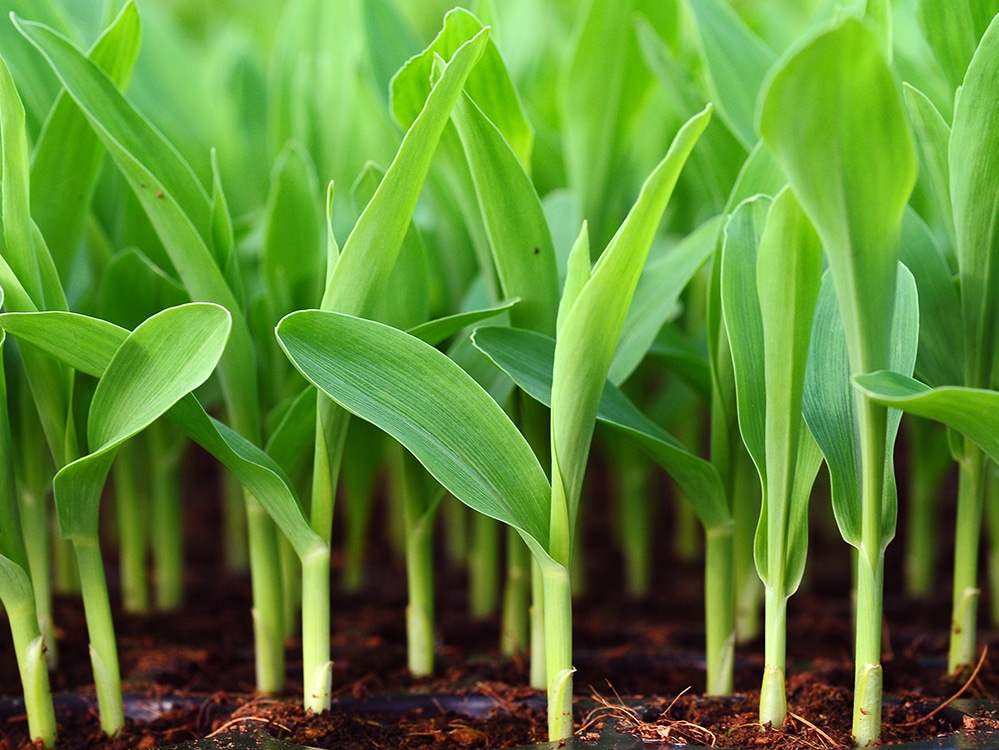
Whether you’re growing from seed or buying your plants, keep your young corn warm and indoors. Even those varieties that are better suited to cooler conditions perform poorly when started outside. On top of which, tardy development due to an outdoor start = less chance of any harvest at all if the summer’s a duffer.
Seeds, seedlings, and early veg stage plants want a propagation lid. They want temps of about 19–21°C and they want to be brought along as far as possible in a nice, cosy environment. Once the last frosts have truly passed, once the plants are around 10cm in height, and once they look suitably vigorous – then, and only then, should you consider planting out.
Nurturing Your Corns
Regular, accurate, consistent irrigation is one definite plus where nurturing young corn is concerned. Our most recent crop started out on a Tray2Grow automatic plant watering system at AutoPot HQ.
Set up with capillary matting, the system received the gift of corn seedlings in multi-cell trays. Once the plants were well enough developed, they were transferred into small pots before going straight back onto the Tray2Grow.
With Tray2Grow the upward wicking of moisture from the system, through the matting, and onwards to the seed trays or pots is dictated by plant uptake alone, so it can be as gradual as is required. This is a great way of ensuring that seeds and young plants are never dried out or inundated.
Is that all Tray2Grow has to offer when growing corn? Come on now, let’s not play games with one another.
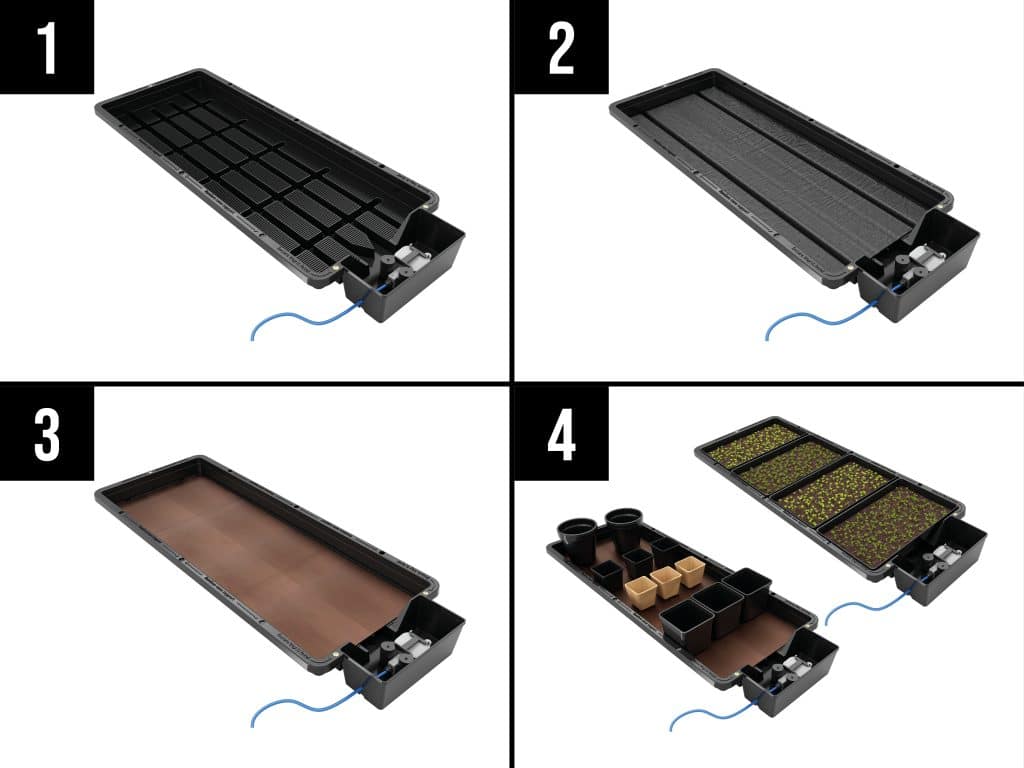
3. Root control in place – 4. Seed trays or pots added
A Moveable Feast
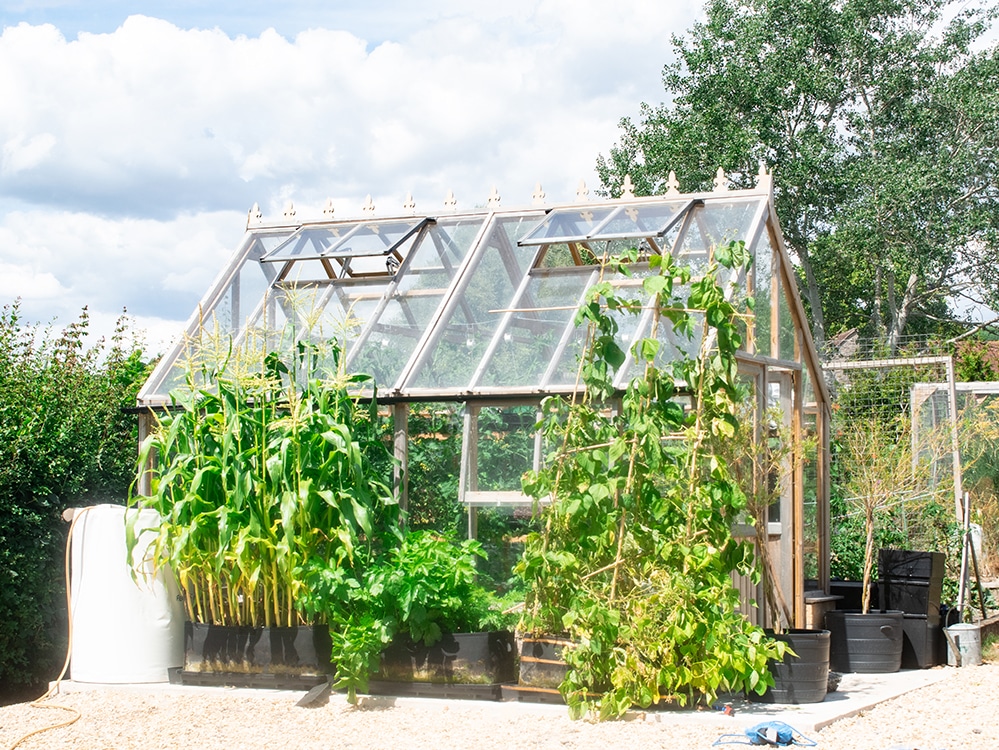
Corn thrives when given an abundance of warmth and light. So we needed to devote a really good spot to the plants. Because the stalks get as tall as they do (6ft minimum), we also needed a growing space that was relatively sheltered from the wind.
The sheltered side of our greenhouse in sunny Wiltshire would have been ideal. But there are no beds or plots on the less-windswept side. And the windier side (with the beds on) is too shady for corn. Again, the solution to the problem was Tray2Grow.
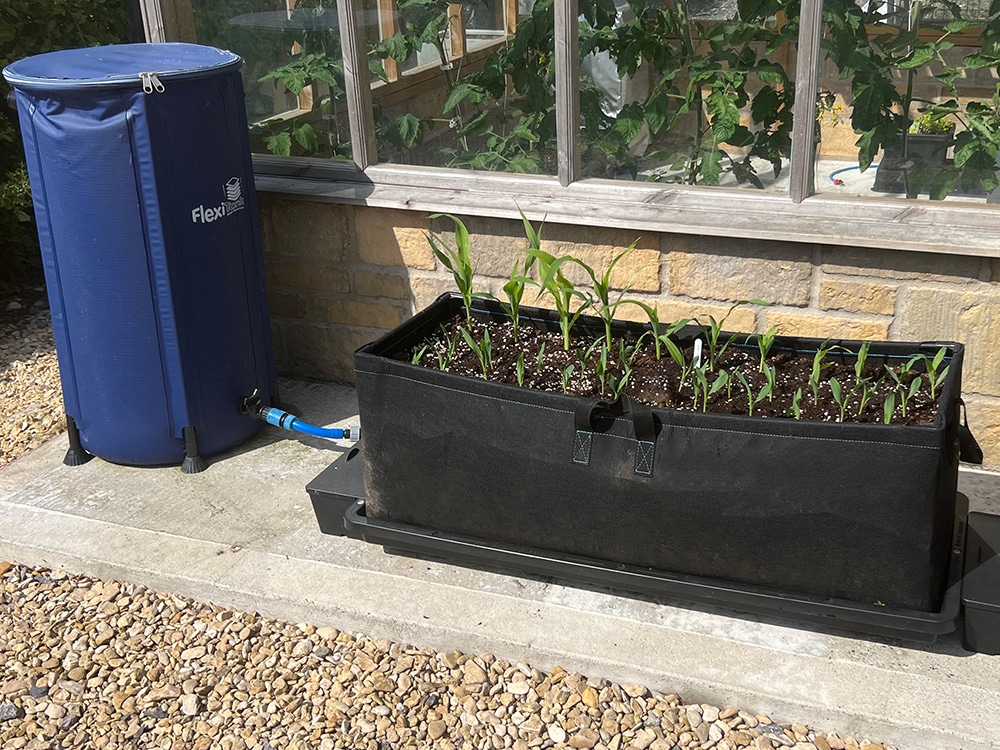
We simply assembled a system in exactly the desired spot and placed one of our 107.5L fabric planters onto the tray. The planter was filled with a light, aerated grow media – in this case, Biobizz Light Mix – et voila! The perfect plot.
We connected the system up to a reservoir and immediately had automated plant watering and feeding to boot. Because the system requires no mains water or electricity to function, you really can position it just about anywhere.
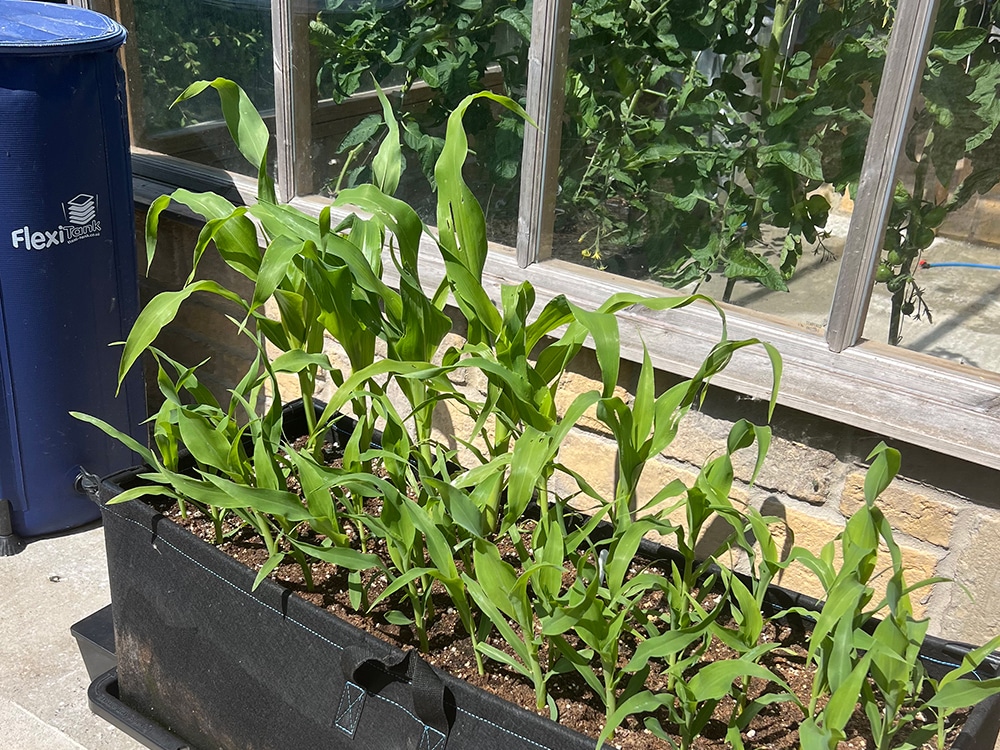
and with no mains water required – meaning it’s good to go, practically anywhere
Planting Out
Thanks to an exceptionally warm spring this year, we were able to plant out as early as April 25th. It was one of those all-too-rare occasions where it was important to take advantage of the incredibly conducive conditions outside.
The Tray2Grow Planter is ideally suited to the kind of ‘block planting’ patterns in which sweetcorn thrives. As sweetcorn is a wind-pollinated grass, the close proximity of plants only boosts the chances of maximum yields. Close is good, multiple plants are good, but what constitutes overcrowding?
Whilst some suggest allowing at least a 0.3m / 1ft in distance between plants, Jason Ralph-Smith (AutoPot MD) was game for a much denser arrangement. Just a few inches separate each of the 30 or so plants in our setup.
This density has necessitated the removal of any low side shoots in order to keep the stems well ventilated and the plants focused on upward growth. But, in reality, there’s been very little else to do in terms of extra maintenance.

in decorative language – including ‘Tassels’ (left) and ‘Silks’ (right)
Corn Wall
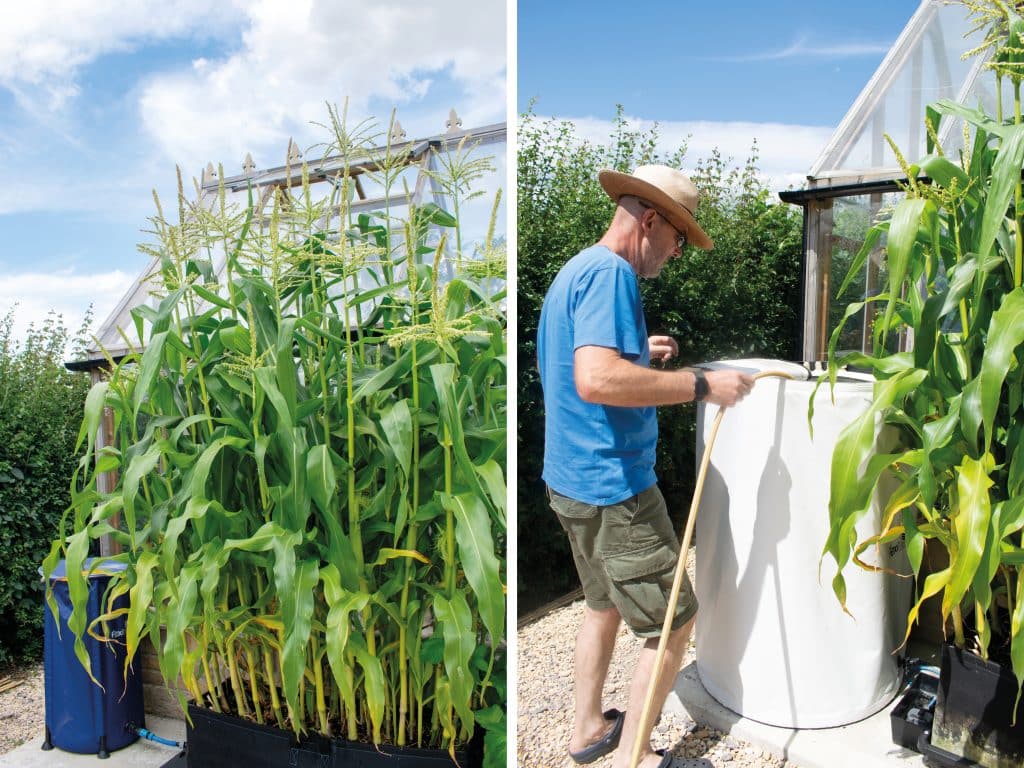
In the course of three months, the young plants (approx 15cm / 6” tall) have rocketed to well over 2m / 7ft. And that’s a conservative estimate with the height of the planter itself subtracted.
The depth of the planter appears to be providing an excellent foundation, and the porous fabric sidewalls really do seem to be delivering as advertised. Because air can access the rootzone via the wall,s you get supercharged growth – which is what we’re seeing here.
A few weeks ago, the male flowerheads at the top of the plants opened and, in that time-honoured way, lavished their pollen upon the female flowers below. This is a process you can accelerate by simply shaking the stalks a little if desired. The ‘children of the corn’ (cobs) have now started to form and should be fully developed by late summer / early autumn.
Examining Your Corns
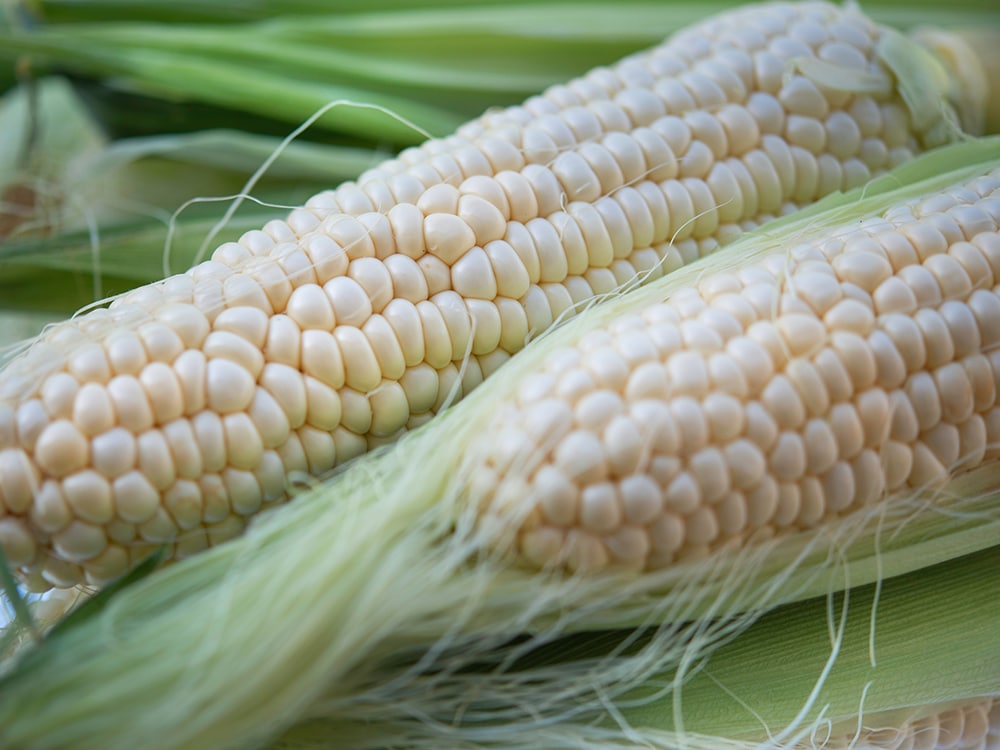
Even though our corn is still some way from harvest time, it’s still well worth covering how to examine the crops for ripeness. With corn, it’s essential that you harvest when the moment is right. Check out the silks at the end of the cob – have they browned? If so take a peek inside. Don’t peel too much. Go easy. You’re Charlie Bucket, looking for the last Golden Ticket at this point.
Inside the cob, pierce a kernel or two and see what comes out. If the juice runs clear, it’s not ready (it’s not like chicken, is it!). If the juices are milky, it is ready (it’s not like chicken, is it!). If you get a paste, it’s too far gone, although you can still use it for popcorn (it’s not like chicken, is it!).
Cob Gobblin’
Come September, we hope to be wolfing down our cobs like they’re going out of fashion / before the sugars in the fruits turn to starch and they become inedible.
Yes, homegrown sweetcorn can be something of a flash in the pan once harvested, but that’s exactly the point. All the work goes into a few ecstatic moments of otherwise unattainable sweetness and flavour – one golden glance, of what could be. Before ‘Eldorado’s Eyes’ (another made-up name for corn) closes once more. Follow our onward progress to that promised land with regular greenhouse updates on @autopot_global and @AutoPotSystems